How to read your own roof from the ground
By the time water comes through a ceiling, the roof has usually been telling you for a couple of seasons. Here is what it was saying.
September 16, 2026 · 4 min read
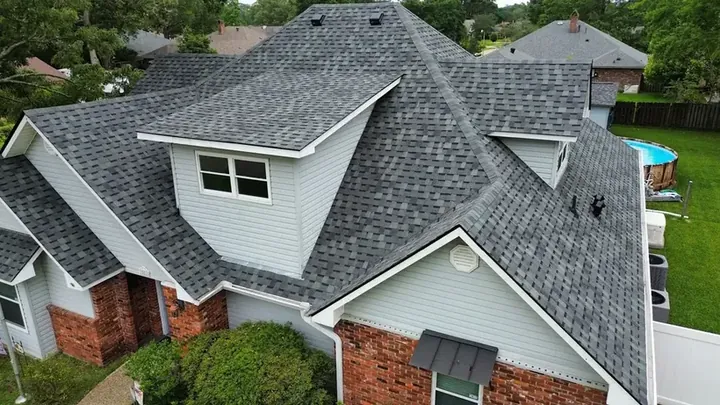
Nobody wants to pay for a roof inspection on a roof that turns out to be fine. So most people wait, and the thing they wait for is a stain on a ceiling. That is the worst possible signal to wait for, because by then water has already been in the structure long enough to find its way through insulation, decking and drywall, and the repair is no longer only a roofing repair.
The useful signals arrive years earlier and you can check most of them yourself in about ten minutes, without a ladder. Here is what to look for on a house in Gonzales, Prairieville, Baton Rouge or anywhere else along this stretch of Louisiana.
1. The grit in your gutter is the roof
Asphalt shingles are covered in mineral granules. Those granules are what protects the asphalt underneath from ultraviolet light, and they are the single most honest wear indicator a roof has. As a shingle ages, it sheds them, and they wash down into the gutter.
Almost everybody who cleans a gutter scoops out a layer of coarse dark grit and assumes it is dirt from the trees. It is not. It is the surface of the roof. A small amount is normal, particularly on a roof in its first year while the loose factory granules wash off. A gutter that fills with grit every time you clean it is a roof running out of protective surface, and once the asphalt underneath is exposed the countdown speeds up considerably.
2. Shingles that have stopped lying flat
Walk out to the far side of the street and look back at your own roof. You are looking for a plane that should read as a flat, even field of colour. What you do not want to see is texture: edges lifting, corners curling upward, or shingles that look blistered or bubbled.
Curling is heat and age. Lifting and flapping is usually wind that has broken the seal strip, and it matters more than it looks because a shingle that is no longer sealed to the one below it is an open door for the next storm. If you can see shingles moving on a windy day, that is not a cosmetic problem.
3. A roofline that is not straight
Sight along the ridge and along the eaves from the street. Both should be dead straight. A dip, a sag or a wave in a plane means the decking under the shingles has been wet long enough to lose its stiffness, or that something structural underneath has moved.
This one is genuinely urgent. Sagging decking is water that is already in the assembly, and it is the difference between a roof replacement and a roof replacement plus a decking replacement plus interior repairs. If you can see it from the ground, do not sit on it.
4. Ceilings and eaves, from inside and underneath
Inside, look at ceilings in the rooms directly under the roof, and particularly in corners, in closets and above stairwells, which are the rooms nobody stands in for long. Faint brown rings that come and go with the weather are old news being repeated.
Outside, look up at the eaves and the fascia board where the gutter hangs. Damaged or soft eaves, peeling paint on the fascia, or a gutter that has started to pull away from the house all point at water going behind the gutter rather than into it, which is a detail where the roof edge and the gutter have stopped agreeing with each other.
5. The power bill nobody connects to the roof
A roof and the attic beneath it are part of the building's thermal envelope. When a roof assembly is failing, ventilation is compromised or insulation has got damp, the air conditioning runs longer to hold the same temperature. In a Louisiana summer that shows up on a bill quickly.
On its own, a higher bill proves nothing. Alongside two or three of the signs above, it is corroboration.
What to do with what you found
Our advice is the same as the advice on our FAQ page: have the roof inspected at least twice a year. Age counts as its own signal, because a typical roof lasts 25 to 50 years and anything past twenty deserves looking at whether or not it has obviously failed.
- Granules building up in the gutter every time you clean it
- Shingles curling, blistering, lifting or flapping
- A dip, sag or wave along a ridge or an eave
- Stains on interior ceilings, or soft and damaged eaves outside
- Cooling costs climbing with no other explanation
If two or more of those describe your house, the next step costs nothing. A Cypress Roofing evaluation is free and happens within 24 to 48 hours, and it means a roofing contractor actually up on the roof looking at the valleys, the flashing and the penetrations, not a verdict shouted from the driveway. Sometimes the answer is that you have eight good years left, and that is a useful thing to be told too.
Call the office on (225) 238-6147. We are at 13119 Airline Highway in Gonzales, and we cover Ascension Parish, Baton Rouge and the surrounding parishes.
Cypress Roofing, (225) 238-6147
Call (225) 238-6147More articles
What FORTIFIED roofing actually changes, edge by edge
Wind never lifts a roof from the middle. It finds an edge. FORTIFIED is written against that sequence.
How a roof insurance claim really goes, and where it stalls
The roof is the easy part. The claim is where months disappear, and it is usually the same three places.